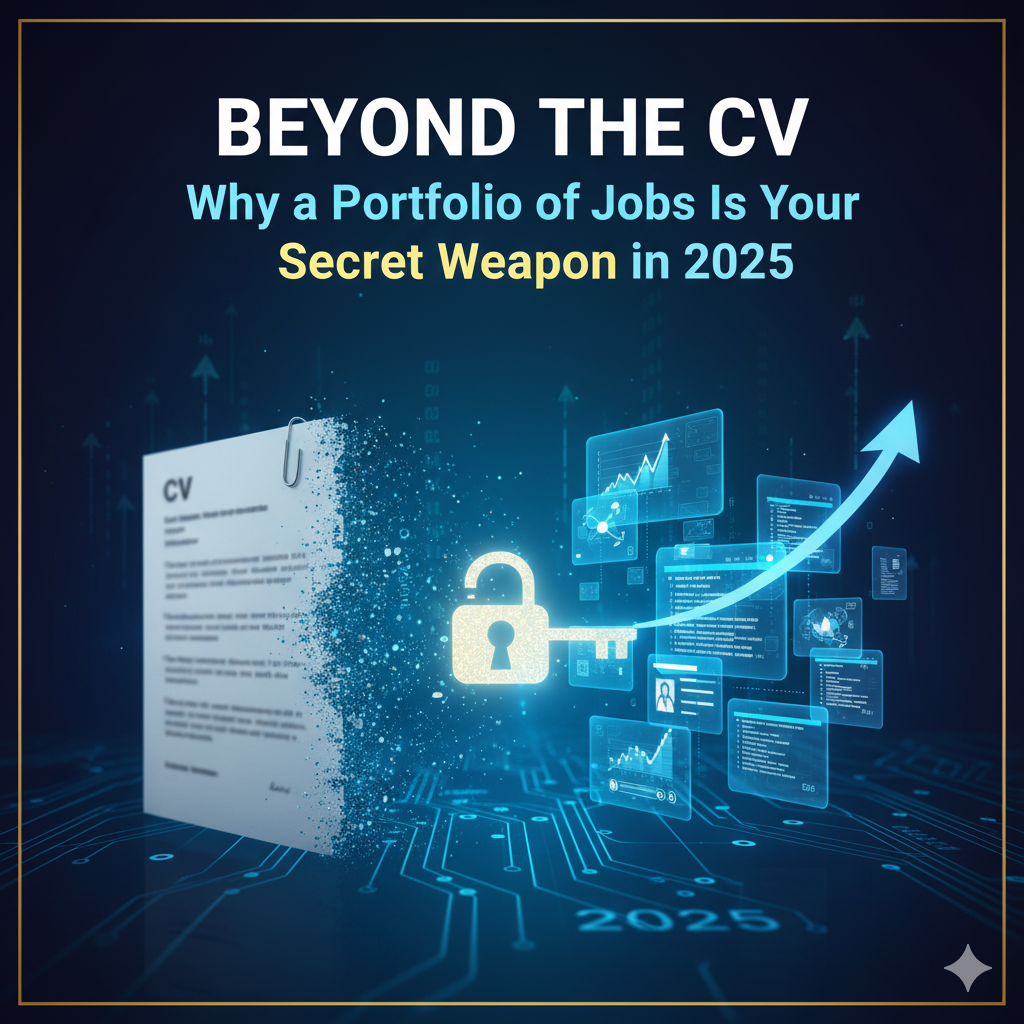
The traditional curriculum vitae (CV) or resume is dead. Or at the very least, it’s severely limited. A static list of job titles and dates simply can’t capture the complexity, the context, and the sheer skill involved in your career journey. In today's dynamic professional world, what truly matters is demonstrating what you can do, not just where you’ve been.
This is why you need to transition from viewing your career as a sequence of entries on a resume to curating a powerful portfolio of jobs. This concept elevates your professional narrative, turning past roles into compelling case studies and proven projects. It’s the difference between telling someone you're capable and actively showing them the results you’ve delivered.
The Evolution of Professional Proof: From Scrolls to Digital Screens
The idea of documenting one’s professional journey isn't new, but the format and accessibility have changed dramatically. Understanding this history clarifies why a modern portfolio of jobs is now essential.
The Original Portfolios: Masters and Apprentices
- The Artisan's Book of Hours: Centuries ago, artisans and craftsmen, particularly in Europe, maintained actual physical portfolios. These books contained samples of their best work, detailed drawings, and sometimes even letters of recommendation from patrons. This collection was required for a journeyman to achieve the status of master in a guild. It wasn't a list of jobs; it was a testament to proven skill.
- The Architect's Ledger: Architects, from the Renaissance onward, kept meticulous records. They didn't just document the name of the building and the client; they recorded the innovative techniques used, the materials sourced, and the challenges overcome. This was an early form of the modern case study, showcasing how they worked.
The Rise and Fall of the Resume
- The 20th Century Standard: The modern CV, popularized during the industrial age, was designed for standardization. Its purpose was administrative: to quickly categorize a large workforce based on duration of service, formal education, and verifiable titles. It was a tool of HR efficiency, not a showcase of individual genius.
- The Digital Disruption: The internet, beginning in the late 1990s, fundamentally challenged the static resume. Suddenly, professionals could host visual, interactive, and multimedia proof of their abilities online. However, the initial phase was largely restricted to creative fields like design and photography.
Today, the line has vanished. Engineers, marketers, consultants, and even lawyers must all think like creatives, using a personalized online portfolio website as their professional headquarters.
Why Curating a Portfolio of Jobs Matters More Than Ever
A traditional CV focuses on past commitment. A portfolio of jobs focuses on future capability. In an economy defined by gig work, rapid technological change, and project-based roles, capability is king.
1. Contextualizes Your Value
A resume says, "I was a Project Manager for three years." A portfolio of jobs shows a case study where:
- Challenge: The project was six months behind schedule.
- Action: You implemented a new Agile workflow and resourced a key bottleneck team.
- Result: The project was delivered on time and 10% under budget.
This narrative transformation is vital. It allows the potential employer or client to instantly understand your problem-solving process and the measurable impact you can deliver for them.
2. Bridges the Skills Gap
In many fields, the skills acquired in a job far exceed what a title suggests. A portfolio allows you to explicitly demonstrate:
- Soft Skills in Action: Did you lead a major restructuring? Showcase a presentation that guided stakeholders through a challenging transition.
- New Technology Mastery: Did you implement a new data visualization tool? Include an interactive dashboard you created or a screenshot with a caption detailing the technical challenge.
- Cross-Disciplinary Work: If your job required blending marketing, finance, and engineering, the portfolio can structure those projects into digestible narratives, something a single job description never could.
3. Future-Proofs Your Career
- As the world's leading organizations, like the Organisation for Economic Co-operation and Development (OECD), stress the need for continuous skill upgrading, the portfolio becomes your documentation of lifelong learning.
- Project-Based Economy: More work is moving toward contract, freelance, and temporary project roles. Your portfolio is the ultimate sales tool for winning these assignments. It replaces the endless back-and-forth of "Can you do this?" with undeniable proof: "Here is where I already did that."
- Personal Brand Foundation: Your curated job portfolio is the bedrock of your personal brand. Consistent, high-quality documentation of your successes builds trust and positions you as a thought leader in your chosen niche. This is a crucial element of your professional identity, as we detail in our guide on why every professional needs a digital portfolio in 2025.
Practical Guide: How to Build a Portfolio of Jobs
Creating this impactful digital collection requires a shift in mindset from reporting to storytelling.
Step 1: Select Your Signature Projects
You do not need to document every single task from every job. Focus on the 5 to 7 projects that best illustrate:
- Highest Impact: The work that generated the largest revenue, saved the most time, or solved the most complex problem.
- Desired Future Role: The projects that align with the next job or client you want to land.
- Range of Skills: Projects that collectively demonstrate a breadth of hard and soft skills, from technical execution to leadership.
Step 2: Structure Each Project as a Case Study
Each project is a chapter in your professional story. Follow the STAR (Situation, Task, Action, Result) method, but expand it for visual impact.
- Title and Context: Give the project a compelling title, not just the official job name. Briefly explain the client, the timeline, and the industry.
- The Situation/Challenge: Clearly articulate the problem you were hired to solve. What was the difficulty, or what was the desired outcome?
- Your Action & Process: This is the most important part. Use visuals (screenshots, wireframes, charts, code snippets) to illustrate how you worked. Detail the unique methodology or approach you took.
- The Results (The Payoff): Quantify the outcome. Use numbers, percentages, or testimonial quotes. If you can’t use exact client data, use percentages or indexed metrics (e.g., "Increased conversion rate by X%").
Step 3: Integrate Your Digital Tools
Your portfolio of jobs shouldn't just be static text. It should integrate various media to maximize engagement.
- Embed Media: Instead of just describing a presentation, embed the slideshow itself using tools like SlideShare. Embed video clips demonstrating a software process or a public speaking engagement.
- Use Clear, Professional Design: The presentation matters. Use a clean layout with ample white space. Ensure your site loads quickly and is mobile-responsive. If you are struggling with this, our article on creating online portfolio websites free: how to build yours today offers a great starting point.
- Ensure Easy Navigation: Organize your projects by skill (e.g., "Data Analysis," "Client Strategy," "Product Design") or by industry, making it simple for a visitor to find exactly what they are looking for.
Step 4: Maintain the Portfolio Actively
A portfolio is a living document. You should treat it with the same care you would a client relationship.
- Update Quarterly: Set a reminder to review your case studies and add new results or projects every three months.
- Solicit Testimonials: Treat every successful project or job as an opportunity to gain a powerful, quotable testimonial to add to the relevant case study. Authenticity sells.
- Link Everything: Your portfolio is your hub. Ensure your portfolio link is prominently displayed on your LinkedIn profile, email signature, and business cards.
By shifting your focus to a meticulously curated portfolio of jobs, you move past the limitations of the old resume. You become the narrator of your career, and your successes speak for themselves, powerfully and credibly.